|

Recent Feedback
Red Hunter Wellies
"The wellies arrived promptly and perfectly and just in time for the snow.
Great price and service"
Thank You
Alison Ford
Staffordshire
Chocolate Hunter Wellies
"I received the boots I ordered yesterday, 24 hours after they were ordered. Very efficient thank you, now I have lovely dry feet"
Louise
Hampshire
Garden Fire Basket
"Thank you for the prompt delivery (24hrs) of my garden fire, I love it. I am extremely impressed with your company"
Mrs Woodham
Yorkshire
Spear & Jackson Spade
"WOW!!!! What service. Arrived in less than 48hours. Shall be using you again and recommending to all my gardening friends!"
Mrs Smith
Kent
Windowsill Propagator
"Your service continues to please me. This is my 3rd purchase from you and the service along with the product is second to none."
Mr D Bryer
Surrey
Google Customer Reviews
Rated 4.8 out of 5
Read Reviews
|
|
|
|
| |
 |
|
 |
 |
Growing Garden Bulbs
At garden4less.co.uk
we have put this simple buying guide together to ensure that you select the correct
bulbs for your spring or summer display.
Bulbs come in many colours, sizes, shapes and flower at
different times of the year. To help you we cover bulb availability, what to
look for and how to ensure that you are buying a quality bulb at the right
price.
|

|
Availability
Garden bulbs tend to be available during two distinct
periods of the year.
Autumn Planting Bulbs are usually available
from late August onwards ready for planting in the Autumn,
up until the ground becomes hard, and flower from Spring onwards.
These autumn planting bulbs
include Tulips, Daffodils, Snowdrops, Crocus, Alliums and
many more. The majority of these bulbs can be planted and
then left in the ground for future years. However there are
a few that will benefit from being lifted such as certain
alliums. Spring Planting Bulbs and Tubers available from early spring
are for planting spring onwards ready for summer displays.
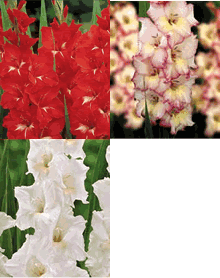
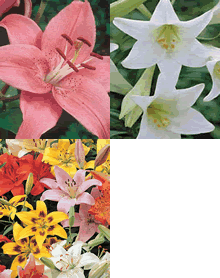
These mainly include Gladioli, Begonias. Dahlias, and
Lilies. Generally these will need lifting in Autumn as they
are not winter hardy.
|
|
Buying Bulbs
When looking at bulbs you should find that there are 2 or 3
sizes or measurements on the description. These are the
following:-
Planting Depth (PD):
Although this probably isn't an important part of the buying
decision it will allow you to plant the bulbs at the correct
depth in the ground.
Full Height (FH): If you are planning a display then
the height of the plant may be important to you. You may
want to mix Tulips of different heights to add variation, or
you may simply want to place smaller plants at the front of
a display and taller more prominent bulbs at the rear.
Bulb Sizes (BS): The bulb size defines the quality of
the bulb. You will find that you can buy certain bulbs in
bulk or value packs and also in smaller pre packs. Yet the
price may vary. This will be down to the grade of the bulb.
Smaller bulbs will not produce a plant that is as strong as
a larger bulb of the same type. So its worth being wary of
value packs or offers where the bulb size is not specified. |

|


|
Planting Bulbs Its often the case that bulbs
are just thrown into the ground with no care or planning and
although this can often work there are steps that can be taken
to produce much more amazing results. Soil Quality
Before planting takes place the soil could benefit from a little
attention. Heavy clay earth can be improved by digging in
compost or other organic material, ideally down to around 18
inches.
All bulbs need phosphorous to aid in the development of the
roots. The phosphorous needs to be mixed in the soil below the
planting depth of the bulb so that the bulbs roots can get easy
access. The bulbs will also benefot from a mix of Bonemeal and
Superphospate.
Planting the Bulb
As previously mentioned the planting depth of the bulb is
important. It may be best to use a bulb planter as many include
a measure on the side to gauge the depth. Alternatively it could
be quicker to loosen the ground to the correct depth over a
large area and simply push the bulbs in the ground and cover
with soil. |
|
 |
 |
|
|
| |
|
|
|
|